
First Steelhead, One Missing Fly
The weather was decent for January in the Pacific Northwest, which mostly meant it wasn’t raining.
It was still cold.
We met early at the local grocery and hardware store for provisions and something warm. Tea for me. Coffee for my fishing partner, who we’ll call C.
C had been fishing for steelhead considerably longer than I had and had agreed to show me around, offer some guidance on Spey casting, and generally increase the likelihood that I might eventually understand what I was doing.
This was the second day of the trip.
The first had ended the way a great many Olympic Peninsula steelhead days end.
No fish.
It had still been a good day.
On the second morning, however, expectations had somehow survived intact. We had higher hopes. Optimism is important in steelheading, mostly because there isn’t much evidence to support it.
You don’t get what you don’t ask for.
Or something like that.
We launched at a semi-secret location on the river. I couldn’t tell you exactly where it was now, even if I wanted to, which feels appropriate.
We floated a short distance to the first run.
The water was cold. The wind seemed determined not to be outdone.
I stepped out of the boat and into the river and went back to the work of trying to make everything happen at once: get the cast right, get the fly down, control the swing, understand the current, and look vaguely like I belonged there.
Cast.
Swing.
Step.
Repeat.
Nothing.
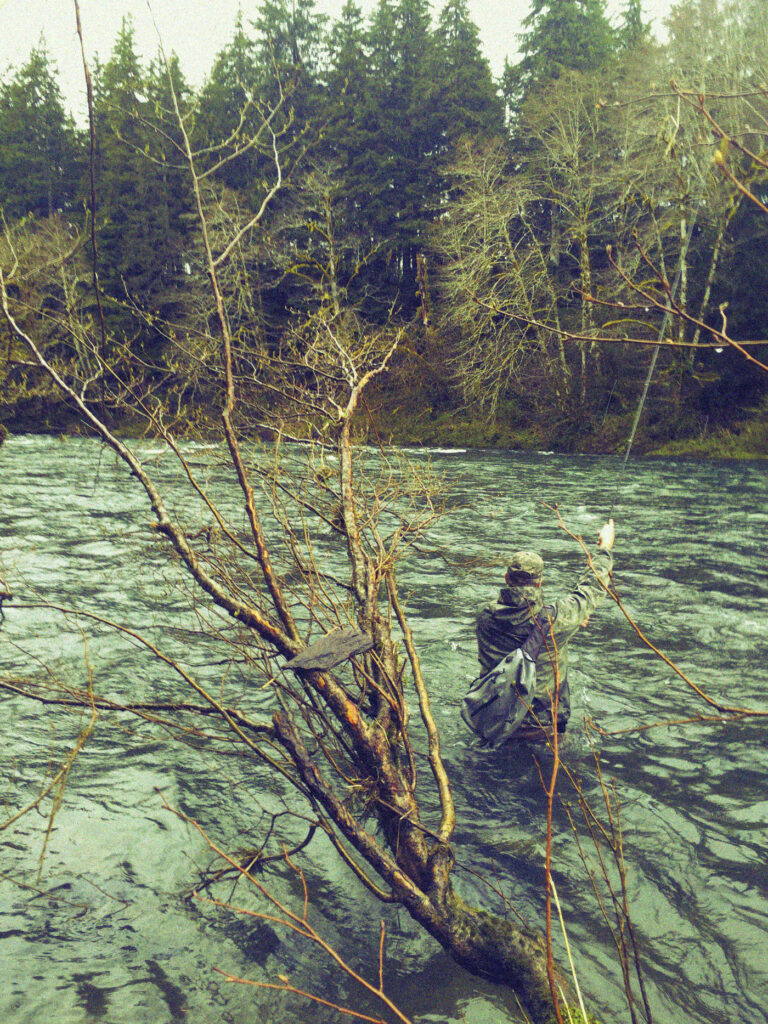
The first run was not meant to be.
We climbed back into the boat and drifted farther downstream.
The second spot looked promising.
Most places on an Olympic Peninsula river look promising, which is part of the problem. A beautiful run without a steelhead in it is still just a beautiful run.
C let me fish through first. He was planning to fish a little deeper than my setup allowed.
As I started at the head of the run, he mentioned a large boulder farther down.
There were often fish around it.
Useful information.
Also dangerous information.
I started working my way toward it.
Cast.
Swing.
Step.
Repeat.
Eventually the fly came around the boulder and approached the end of the swing.
I felt a tug.
Every instinct told me to do something.
Fortunately, I remembered the last time this had happened. I had responded by enthusiastically setting the hook and pulling the fly directly out of the fish’s mouth.
A lesson had been issued.
Apparently it had been retained.
So I stood there.
Tug.
Tug.
Tug.
Then the reel started clicking.
Line began leaving.
We were on.
This was my first steelhead, and I had very little idea what I was supposed to do next.
I yelled upstream to C.
He was smiling.
“You’re doing great.”
This seemed unlikely.
From my perspective, I was mostly standing in the river while a fish removed line from my reel.
As it turns out, that is sometimes exactly what you’re supposed to do.
There was some back and forth. A couple of jumps. Enough commotion to make the previous two days disappear entirely.
Then everything changed.
The fish stopped feeling like a fish.
It felt like dead weight.
A rock?
A branch?
Had I lost it?
Then I saw silver roll beneath the surface.
Still there.
C suggested I put a little more pressure on it and slowly swing the fish toward shore.
I did so with considerably more caution than confidence.
As the fish came into the shallows, the problem revealed itself.
At some point during the fight, the line had wrapped around the steelhead.
That explained the dead weight.
C tailed the fish and carefully unwound the line from its body.
Wild steelhead.
Silver, alive, and suddenly much larger now that it was in my hands.
I gave C my phone and asked him to grab a quick photo before we sent it back.
He got the picture.
The fish had apparently decided that was sufficient documentation.
It bucked out of my hands and headed for the river.
There was one complication.
The fly was still in its mouth.
The sudden escape pulled the line into the rocks along shore, tangled it, and snapped the tippet.
The fish disappeared.
So did the fly.
For a while I was disappointed about that. I had wanted to keep the fly from my first steelhead.
Later I realized the fish may have done me a favor.
There was a knot in my tippet.
Had the line not wrapped around the fish during the fight, there is a very good chance that knot would have failed long before we ever got it to shore.
Whether the fish wrapped itself deliberately remains outside the scope of this report.
Records are kept without announcement.
Afterward, I needed a minute.
My hands were shaking enough that casting didn’t seem particularly useful anyway.
I sat in the boat where it rested on the beach and replayed the whole thing.
The tug.
The reel.
The jumps.
That flash of silver under the water.
The brief weight of a wild steelhead in my hands.
Then nothing but the river again.
Somewhere downstream, a steelhead was swimming away with my fly.
Somewhere on shore, I was trying to decide whether it was too early for a beer.
It probably was.
That doesn’t mean the question wasn’t asked.
FINDING
A tug is not always an instruction.
Large boulders remain suspicious.
Knots in tippet should be addressed before they become part of the story.
Wild steelhead are not interested in photographs, keepsakes, or ceremony.
The first fish rarely leaves everything exactly as it found it.
It was, in fact, too early for a beer. This did not improve the situation.